The Full Biography
Sid Caesar. Comedian. The Yonkers saxophonist who made a live Saturday into an American grammar, then spent the quiet decades proving a writers' room can outlive the man who ran it.
This is his story.
The image most people still carry is a large man in a suit, mid-pantomime, speaking a fluent nonsense that sounds like German or French or the language of a professor who has lost his notes, while Imogene Coca tries not to break. The year might be 1952. The program was Your Show of Shows. What the still cannot show is Isaac Sidney Caesar of Yonkers, a luncheonette, a Coast Guard revue, a Saturday that had to be invented every week without tape, and a man who would spend twenty years inside a bottle and then write the bottle down so the room would know what the laughter had cost.
He was born on September 8, 1922, in Yonkers, to Max and Ida Caesar, immigrants who ran a luncheonette. The first languages in the room were the customers' languages. He listened. He played saxophone in dance bands because a horn was a living. The double-talk that would make him famous began as a boy's ear in a place where English was only one of the menus. He did not study comedy as a major. He studied people paying for soup.
The Coast Guard, in the war, put him in Tars and Spars, a service revue. Vernon Duke was in that weather. A film version followed. Max Liebman, who knew how to build a Saturday, took him to television. The Admiral Broadway Revue (1949) was the rehearsal. Your Show of Shows (1950–54), ninety minutes live on NBC, Saturday night, was the occupation. There was no safety net and no second take. A season demanded a small mountain of new sketches. He did movie parodies, marital wars, a professor who could lecture in no known tongue, a man making breakfast as if breakfast were a demolition. Coca was the partner. Carl Reiner and Howard Morris were the company. The writers' room is the part of the file that became a civilization.

Mel Tolkin. Lucille Kallen. Mel Brooks. Then Neil Simon. Larry Gelbart. Woody Allen came onto Caesar's Hour. Carl Reiner was in the room and on the floor; he would, in time, build The Dick Van Dyke Show out of the memory of writing for a man like Caesar in an office like that office. The room was not a salon. It was a weekly emergency. They wrote "From Here to Obscurity" and a dozen other movie parodies that treated Hollywood as a language a live audience already spoke. They wrote husbands and wives in kitchen wars that still play as if the kitchen had not changed. They wrote the Professor, a man who could lecture in no known tongue and still be understood. Caesar, who could be volcanic, who could be generous, who could throw a punch at a line and at a person, presided over a shop that trained half of the next half-century of American comedy. Brooks has told the stories — the tyrant, the love, the sketches written in a sweat. Simon has written the rooms into plays that still have that cadence. Reiner made the rooms into a series about a writer who goes home to New Rochelle. The origin is Yonkers and a Saturday clock. The live constraint is the thing the kinescopes cannot fully restore. Ninety minutes. No tape to save a blown line. A studio audience in New York and a country on the other side of a lens. He prepared like a musician: the pantomime had beats, the double-talk had a key, the breakfast sketch had to land on a piece of toast as if toast were a punch line you could eat. Coca was the equal, not the feed. Their marital sketches are a two-person instrument. When she left after the first series, the instrument changed key. It did not stop being music.
Caesar's Hour (1954–57) was the second live mountain, Nanette Fabray in Coca's old weather, more Emmys, the same impossible pace. He won a performing Emmy. The variety show as a civic habit still had a few years left. Then the habit ended. Tape arrived. The ninety-minute live sketch became a memory. He did specials. He did a stretch on ABC that did not hold. The body that had carried Saturday began to look for something that would carry the body.
Comedy has to be based on truth. You take the truth and you put a little curlicue at the end.Sid Caesar
The pictures are a second, thinner career that the live years make look like a coda. It's a Mad, Mad, Mad, Mad World (1963), a treasure hunt in a car. Mel Brooks brought him back for Silent Movie (1976) and History of the World, Part I (1981). Grease (1978) made him Coach Calhoun, a gym teacher in a musical the whole country bought, a credit teenagers still recognize without knowing about Coca. Airport 1975. The work was there. The Saturday was not. What filled the Saturday was alcohol and pills, Seconal, a twenty-year fog he would, in 1982, describe in Where Have I Been? The memoir is not a comic monologue. It is a man counting the rooms he could not remember and the marriage he almost spent.
He had married Florence Levy in 1943. The marriage lasted until her death in 2010 — sixty-seven years, three children, Michele, Rick, and Karen, a household that had to share a husband and father who was also a weekly emergency and then a man in a fog. Florence is the private steel the tributes sometimes remember to name. Friends from the NBC years describe a performer who could hold a pantomime longer than a reasonable person would dare, and a boss who could clear a room. Both are the life. The curlicue at the end of the truth was the act. The truth underneath was a luncheonette ear and a nervous system that had been asked to invent ninety minutes a week.
Six things most people never knew
- The luncheonette was the first language lab. Yonkers. Immigrant customers. Double-talk began as listening, not as a nightclub trick.
- The horn came before the sketch. A working saxophonist. Comedy was the second instrument.
- Reiner built a series out of the office. The Dick Van Dyke Show is a memory of Caesar's shop, moved to New Rochelle and made gentle.
- Woody Allen was an Hour writer, not a Show of Shows writer. The rooms are two rooms. The mythology collapses them. The dates do not.
- Florence lasted sixty-seven years. 1943 to 2010. The fog did not end the marriage. She outlasted the fog and died first.
- Where Have I Been? is 1982. A recovery document, not a clip reel. He put the Seconal on the page himself.
The turn is the recovery and the memoir, and it is easy to miss because the public remembers the double-talk. The turn is that he got sober enough to become a teacher of his own history, a man who would sit with young comics and with documentary crews and say what Saturday had required. A lot of live-television giants became a joke about how television used to be. He became the primary source.
The later years
The years after the fog are a long, quieter fame. He appeared, when asked, as himself: the last surviving head of a certain Saturday, a man Brooks still introduced as a god of the form. He did Vegas Vacation (1997). He did the talk shows that still knew who Coca was. He collected lifetime Emmys and the kind of honors the industry gives a founder when the founder is still able to walk onstage and pantomime a man making toast. The Television Academy made him a monument while he could still do the bit. He taught, informally, by letting people into the stories — master classes, documentary interviews, a young comic in a green room who wanted to know how you hold a silence on live television. The writers he had hired were now the establishment. They used their platforms to keep his name in the present tense. He published Caesar's Hours after the first memoir, a second look at the work rather than the fog, sketches remembered with a craftsman's pride. He sat for The Sid Caesar Collection on home video, introducing kinescopes to a generation that had only heard the writers' names. He was, in those living-room hours, a large old man pointing at a younger large man and explaining the toast. The explanation is part of the late file. So is the ordinary day in Beverly Hills: a walk, a meal Florence had decided on, a grandchild, a telephone call from Brooks that was half a joke and half a check-in. Recovery is not a closing credit. It is a daily decision a man in his seventies and eighties still has to make. He made it. The double-talk stayed available. The bottle did not get the last Saturday.
Beverly Hills was the house. Florence was the daily companion until 2010. After that the house was a widower's house with children and grandchildren and a telephone that still rang when a documentary needed the Saturday explained. He was not a recluse and he was not a nightclub act on a sad circuit. He was a retired instrument who would, for the right room, pick up the double-talk and let it run until the room understood that the nonsense had always been music. Friends from the last decades describe a large old man who could still do the professor and then ask, quite seriously, whether you had eaten. The luncheonette had never quite left. He appeared at anniversary specials and at the kind of museum evenings that try to explain live television to people who have only known tape. He would stand, sometimes with a cane, and do two minutes of the old pantomime, and the room would remember why a Saturday without a net had been a popular art and not a stunt. Young writers from Saturday Night Live and the cable sketch shows came to shake his hand and to hear, if they were lucky, that the sketch still had to be true before it could be bent. He gave them the curlicue sentence. He did not give them a theory of television. He had been too busy, in 1952, to have a theory. The work was the theory. In the last quiet years the work was remembering the work clearly enough that someone else could steal it honestly.
He watched comedy move to tape, then to cable, then to a thousand small screens, and he did not pretend the new rooms were his rooms. He claimed only the live one. That claim was enough. Every sketch show that still tries to build a world in seven minutes is in his debt whether it knows the name Tolkin or not. Every writers' room that runs on panic and invention is a descendant. He knew that. He did not always know how to live besides that. The memoir is the proof he learned, late, to live besides that.
He died on February 12, 2014, in Beverly Hills, at ninety-one. Coca was already gone. Reiner was still here and spoke. Brooks spoke. The obituaries led with the live Saturday and the famous shop. The better ones remembered the saxophone, the luncheonette, Florence, and the twenty years he had to climb out of. Two days after his death, another American Saturday — Shirley Temple Black — would leave the file. They had shared almost nothing except a century and a February. Comedy and the Good Ship, departing in the same week. The coincidence is not a meaning. It is a calendar.
What those last years were, in the daily sense, was an old man in a chair who could still clear a living room without standing up, telling the truth with a curlicue, and then asking after your parents. He had already been the weekly emergency. He spent the end of the file as the historian of the emergency. That is a decent second occupation for a man who once had to be new every Saturday at eight.
After he was gone
The kinescopes remain, grainy, a little fast, still funny. The writers' names became the culture. Reiner's series still teaches the office. Brooks still tells the story of the tyrant he loved. Simon's plays still have the cadence of a room that had to deliver by dress. The children remain. The double-talk, if you can find a clean clip, still sounds like a language you almost know.
He came out of a Yonkers luncheonette, played the horn, learned the customers' mouths, built a Saturday with Coca, hired a civilization, fell into a fog, wrote the fog down, and died a primary source. If you only remember the nonsense German, you have the bit. If you remember the soup counter, the shop, Florence, and the memoir, you have him.
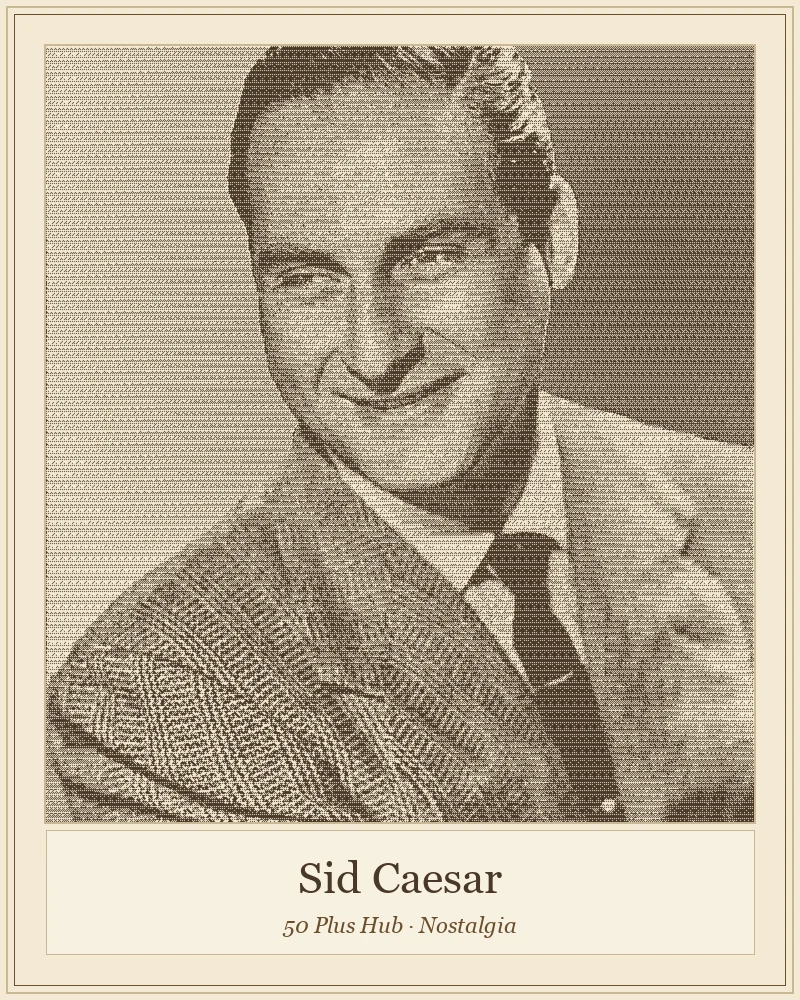
Portrait: News service · Public domain (published 1931-1977 without copyright notice) · via Wikimedia Commons