
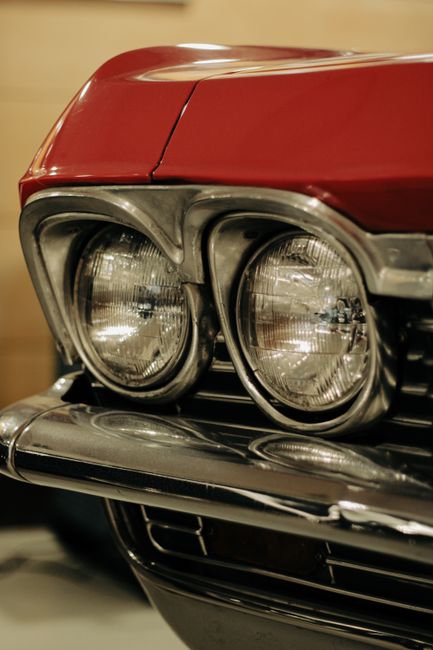
The 1969 Camaro Z28 occupies a singular place in American automotive history. Born from a racing loophole, powered by an engine that General Motors officially pretended made less power than it actually did, and styled with the most aggressive sheet metal of the first-generation Camaro run, the '69 Z28 is the car that proved Chevrolet could beat Ford at its own game — on the track and in the showroom. More than half a century later, clean examples routinely cross the six-figure mark at auction, and the car's reputation as a blue-chip collectible has only strengthened with time. Here is everything you need to know about what makes this car special, what it is worth today, and how to avoid buying a fake.
The Z28 exists because of a rule book. In the mid-1960s, the Sports Car Club of America's Trans-American Sedan Championship (Trans-Am) was the most prestigious road-racing series for production-based sedans in North America. The series had one critical regulation: engine displacement could not exceed 305 cubic inches (5.0 liters). Ford was already dominating Trans-Am with the Mustang, and Chevrolet's performance chief Vince Piggins saw an opportunity.
Piggins proposed a special Camaro package built around a destroked 327ci small-block bored to 4.001 inches with a 3.0-inch stroke crankshaft from the 283, yielding exactly 302.4 cubic inches — safely under the 305ci limit. The SCCA required that at least 1,000 street versions be sold for homologation, so the Regular Production Option (RPO) Z28 was created for the 1967 model year.
Chevrolet never actually called it the "Z28" in advertising that first year. It was simply a $358.10 option package on the order sheet — no badges, no callouts in the brochure. You had to know to ask for it. Only 602 were built in 1967, just barely meeting the SCCA's production minimum. By 1968, word had spread through the enthusiast press, and production jumped to 7,199. But it was 1969 that transformed the Z28 from a homologation special into an icon.
The 1969 Camaro received the most significant styling update of the first generation. The body lines were sharper and more sculpted than the 1967-68 cars, with a lower, wider stance that looked faster standing still. The front end gained a more aggressive grille opening, and the rear featured revised taillights. For the Z28 specifically, the package now included bold "Z28" graphics on the front fenders and rear spoiler — the first time the designation appeared prominently on the car's exterior.
Beyond aesthetics, the '69 Z28 benefited from chassis refinements developed through two years of Trans-Am competition. The suspension was better sorted, the four-speed Muncie M21 (close-ratio) or M22 ("Rock Crusher") transmissions were tougher, and the overall package felt more complete than the earlier cars. No automatic transmission was available — the Z28 was a driver's car, period.
Collectors prize the 1969 over all other first-generation Z28s for several reasons. The styling is universally regarded as the best-looking of the 1967-69 run. Production was high enough (19,014 units) that parts availability and documentation are reasonable, but low enough to maintain genuine scarcity. And the car represented the peak of the first-generation's development — everything Chevrolet had learned in two years of racing was baked into the '69.
The heart of the Z28 was the DZ 302 small-block V8 — one of the most underrated engines in GM history. Chevrolet rated it at 290 horsepower, a figure that everyone in the industry understood was deliberately conservative. Independent dyno tests consistently showed output north of 350 hp, and some well-tuned examples exceeded 370 hp. The low official number was partly to keep insurance premiums reasonable for buyers and partly because GM had an internal policy against offering engines with more than one horsepower per cubic inch in anything smaller than a full-size car.
302.4 cubic inches (4.96L). 4.001" bore x 3.0" stroke. Based on the 327 block with a forged steel 283 crankshaft. Two-bolt main caps on production engines.
High-performance "camel hump" casting #3927186 cylinder heads with 2.02" intake and 1.60" exhaust valves. Solid lifter camshaft with 0.485" lift intake / 0.485" lift exhaust — this engine revved to 7,000+ RPM reliably, unheard of for a production pushrod V8 at the time.
Holley 780 CFM four-barrel carburetor (#4053) on a dual-plane aluminum intake manifold. 11.0:1 compression ratio — this engine demanded premium fuel, which in 1969 meant leaded gasoline with octane ratings above 100.
Factory tubular steel exhaust headers (a rarity for a production car in 1969) flowing into a 2.5" dual exhaust system with deep-tone mufflers. The headers alone were worth 15-20 hp over conventional cast-iron manifolds.
In period testing, the 1969 Z28 was one of the fastest production cars available under $4,000. Its high-revving nature and relatively light weight (approximately 3,300 lbs) gave it a power-to-weight ratio that embarrassed many big-block muscle cars in real-world driving. Here is how it stacked up against its direct Trans-Am competitors:
Notice something? All four cars were officially rated at exactly 290 hp. This was the era of the gentleman's agreement among manufacturers to understate power figures. The Z28's advantage came from its higher actual output, lighter curb weight, and superior chassis tuning derived directly from its Trans-Am racing program.
The Z28's racing pedigree is not some retroactive marketing narrative — it was the car's entire reason for existing. In SCCA Trans-Am competition, the Camaro battled Ford's Mustang Boss 302, the Pontiac Firebird, the AMC Javelin, and the Plymouth Barracuda across a season of grueling road-course events at tracks like Lime Rock, Mid-Ohio, Laguna Seca, and Riverside.
The partnership between driver Mark Donohue and team owner Roger Penske produced the most successful Camaro racing effort. Donohue won the 1968 Trans-Am championship driving a Penske-prepared Camaro Z28, and the team was again a dominant force in 1969. Donohue's driving style — smooth, precise, cerebral — proved that the small-block Camaro could outmaneuver the big-block brutes on a twisting road course even when it was outpowered on the straights.
Other notable teams running Z28s included Jim Hall's Chaparral Cars operation and the factory-backed efforts coordinated through Chevrolet's back-channel support network. While GM officially observed the Automobile Manufacturers Association ban on factory racing, everyone in the paddock knew that Piggins and his team at Chevrolet were providing significant technical and financial support to the top Camaro teams.
This racing heritage matters enormously to collectors. A Z28 is not just a muscle car — it is a homologation special with a documented competition history. That distinction separates it from cars that were simply fast in a straight line and places it in the same conversation as the Shelby GT350, the BMW 3.0 CSL, and the Porsche 911 RS.
Chevrolet offered the 1969 Camaro in a wide palette of colors, and certain combinations are significantly more valuable to collectors today. The following table shows the most notable exterior colors with approximate Z28 production in each:
Key factory options that add significant value include: the JL8 four-wheel disc brakes (extremely rare — fewer than 200 Z28s were so equipped), the cowl-induction hood (RPO ZL2), the M22 "Rock Crusher" close-ratio four-speed transmission, and the rear spoiler. A Z28 equipped with JL8 disc brakes can command a 30-50% premium over an otherwise identical car with standard front-disc/rear-drum brakes.
The 1969 Z28 market has matured significantly over the past two decades. Values peaked during the mid-2000s collector car boom, dipped slightly during the 2008-2010 recession, and have since stabilized at levels that reflect the car's genuine rarity and historical importance. Here are current value ranges based on Hagerty condition classifications:
Special-option cars (JL8 brakes, rare colors, documented race history) can exceed these ranges significantly. Cross-ram intake-equipped cars, dealer-installed performance options, and any car with documented racing provenance occupy their own pricing tier entirely.
Buying a genuine 1969 Z28 requires homework. The difference between a real car and a convincing clone can be worth $50,000 to $150,000. Here is what to check, in order of importance:
The 1969 Camaro VIN is a 13-character code stamped on a plate visible through the windshield on the driver's side. For a legitimate Z28, the fifth character must be "4" (indicating the 302ci V8 engine). The VIN format is: [Division][Series][Body Style][Engine Code][Year][Assembly Plant][Sequence Number]. Example: 124379N500001 — where "4" in the fifth position confirms the DZ 302.
2. The Protect-O-Plate
The Protect-O-Plate lists the RPO Z28 code along with every other factory-installed option. It is stamped in metal and is very difficult to forge convincingly. Many have been lost over the decades, but the presence of this one document can add thousands of dollars to a car's value — and its absence should give any buyer serious pause.
3. Partial VIN Stampings
The engine block, transmission case, and rear axle should all bear partial VIN stampings that match the VIN plate. The engine pad stamping on a Z28 should begin with a two-letter suffix code identifying it as a DZ 302 (common codes: DZ, JL). These stampings should show appropriate aging and should match the style and depth of factory stampings. Restamped pads are detectable by experienced inspectors — the font, depth, and alignment of aftermarket stampings never quite match the originals.
4. Trim Tag Verification
The Fisher Body trim tag (riveted to the cowl area) contains additional encoding including the body style, paint code, trim code, and assembly date. Cross-reference this data with the VIN, Protect-O-Plate, and known production records. The Camaro Research Group maintains a database of documented Z28s that can confirm or flag discrepancies.
5. Physical Inspection
Beyond paperwork, a genuine Z28 should have specific physical characteristics: correct mounting holes for the rear spoiler, the correct front and rear spring pockets (Z28s had unique spring rates), correct brake provisions (whether standard or JL8), and evidence of the factory exhaust header mounting points. An experienced first-generation Camaro appraiser can identify these details in minutes.
The 1969 Camaro Z28 is not just a muscle car — it is a piece of American motorsport history that you can drive on the street. Its combination of racing provenance, mechanical sophistication, aggressive styling, and manageable rarity has kept it at or near the top of the collectible muscle car market for decades. Values have proven resilient through multiple economic cycles, and the car's appeal spans generations — the same engineering that made it a Trans-Am champion in 1969 makes it genuinely fun to drive on a canyon road today.
If you are in the market, do your homework. Verify every document, inspect every stamping, and spend the money on a professional authentication before you write a check. The reward for that diligence is ownership of one of the finest driver's cars Detroit ever produced — and an asset that has consistently appreciated over the past 50 years. There are worse ways to invest six figures.
Get articles like this delivered to your inbox every morning.