
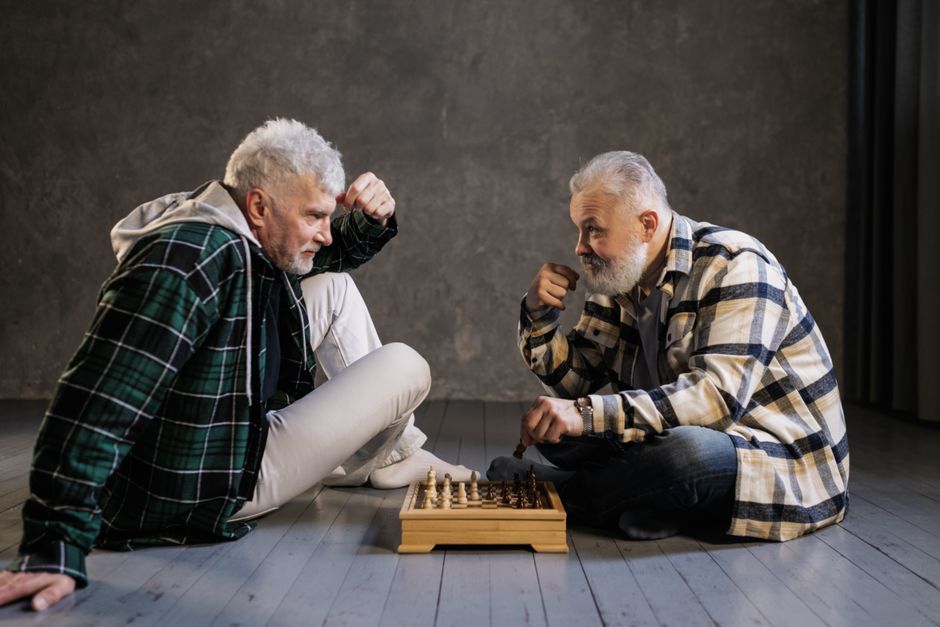
If you tried to play chess in 2010, you needed a board, an opponent, a chess club, and the patience to find someone roughly at your skill level. Twenty years later, chess is in the middle of a global renaissance. The Netflix series 'The Queen's Gambit' brought millions of new players to the game in 2020. The rise of high-quality online platforms made it possible to play any time of day against anyone in the world. And the development of AI analysis tools has made improvement accessible in ways that previous generations of players could only dream of. Chess.com alone now has over 200 million active accounts, and Lichess.org (the leading free alternative) has tens of millions more.
What is interesting for older adults is that this boom has been particularly welcoming to adult learners. The communities on these platforms are large enough that you can almost always find an opponent at your exact skill level — no more being crushed by experts or struggling against rank beginners. The AI analysis lets you understand your mistakes immediately after every game. And the structured learning resources have improved so dramatically that an adult coming back to chess can make more progress in three months in 2026 than they could have made in three years in 1995.
All of this is also great for the brain. Chess is one of the most well-studied hobbies for cognitive benefits in older adults. Multiple studies have found that regular chess play is associated with improved memory, attention, problem-solving, and visuospatial skills, and it has been linked in some research to slower cognitive decline. The combination of pattern recognition, planning, decision-making, and emotional regulation that chess requires uses many of the same brain systems that age can wear on, and exercising those systems is good for them in the same way walking is good for your legs.
There are two free platforms that dominate online chess, and both are excellent. Pick one and start there.
Chess.com is the largest, the most polished, and the one most people gravitate to. It has a generous free tier — you can play unlimited games against humans or computers, do unlimited tactics puzzles, and access basic lessons for free. The paid membership ($5 to $15 per month depending on level) unlocks more lessons and analysis features, but the free version is more than enough for the first six months to a year. Chess.com also has the largest user base, which means you will always find someone to play.
Lichess.org is the open-source alternative — entirely free, no ads, no premium tier, no upsell. It has a slightly more spartan interface but every feature is included for everyone. Many serious chess players prefer Lichess for its ethic of free access. Both platforms work on phones, tablets, and computers, so you can play anywhere.
If you want to play in person, look for a local chess club. The U.S. Chess Federation maintains a directory at uschess.org. Many libraries and community centers also host casual chess gatherings, often on weekday evenings. The combination of online and in-person play is ideal — online for the convenience and the constant availability of opponents, in-person for the social side.
Before you start an improvement plan, figure out where you actually are. Most adults coming back to chess have one of three starting points.
If you are an absolute beginner — you do not know how the pieces move, or you only vaguely remember — start with the Chess.com or Lichess.org beginner tutorial. Both platforms have step-by-step lessons that take you from 'this is a knight' to 'I can play a complete game' in a couple of hours. Do this first.
If you remember the basic rules but have not played in twenty years, start by playing five or ten games against the computer at the lowest difficulty setting, just to get the rust off. Then play a few games against humans at the beginner level. The platforms will give you a rating after a few games and start matching you against opponents at your level.
If you used to be a serious player or you remember the rules well, start by playing rated games right away. The platform will quickly find your level. Then move into the improvement plan below.
Whatever your starting point, do not let pride get in the way. Many adult returners want to skip the basics because they 'used to know this.' Slow down. Spend a few hours on the fundamentals even if you remember them. The fundamentals are where most of the long-term improvement comes from.
Here is a structured plan that produces real progress for adult chess returners. It is based on what most coaches recommend for amateur improvement, condensed into a doable two-month routine.
Weeks 1-2: Tactics. Tactics are short combinations of moves that win material or checkmate, and they are by far the most important thing for adult improvement. Spend 15-20 minutes a day doing tactics puzzles on Chess.com or Lichess. Both have huge databases of puzzles at every level, and they automatically give you ones that match your ability. The single biggest predictor of improvement at any amateur level is tactical sharpness, and puzzles build it directly.
Weeks 3-4: Opening Principles. Do not memorize opening lines. Adults frequently make the mistake of trying to memorize specific opening sequences from books or videos. This is wasted effort. Instead, learn the four basic opening principles: control the center, develop your minor pieces (knights and bishops), castle your king to safety, and connect your rooks. If you follow these principles in every game, you will play decent openings without memorizing anything.
Weeks 5-6: Endgames. Most amateur games end before the endgame, but the few that reach it are decided by knowledge that takes only a few hours to learn. Study the king and pawn endgame, basic checkmates (king and queen vs king, king and rook vs king), and the principle of the active king. The Lichess endgame trainer is excellent and free.
Weeks 7-8: Game Analysis. Play slow games — not the fast 'bullet' or 'blitz' games — and review every single one with the computer analysis afterward. Look for the mistakes you made, understand why they were mistakes, and try not to make the same mistakes next time. Game review is the single most underused improvement tool, and it produces faster progress than any other single habit.
When you play online chess, you choose a time control — how much time each player has for the entire game. The choices range from 'bullet' (1 minute per side) to 'blitz' (3-5 minutes) to 'rapid' (10-30 minutes) to 'classical' (60+ minutes). For adult improvement, the answer is clear: play rapid or classical. Bullet and blitz are fun but they reward instinct and pattern recognition over thinking, and they make you a worse player if you play too much of them.
The sweet spot for most adult learners is 15-minute or 30-minute games (15+10 or 30+0 in the time control notation, where the second number is the increment added per move). These give you enough time to actually think about your moves, calculate ahead, and learn from each game. They also give you enough games per session to build experience without each game taking forever.
Resist the temptation to play fast games. Fast games are entertainment, not improvement, and they reinforce bad habits if they are most of what you do.
One of the most powerful tools available to modern chess learners is computer analysis. After every game on Chess.com or Lichess, you can click a button and the computer will tell you exactly which moves were good, which were bad, and what the better alternatives would have been. This is a tool that grandmasters of the past would have killed for, and it is free for anyone today.
The catch is that computer analysis can be brutal. The engine plays at a level no human can match, and it will mark moves you thought were brilliant as mistakes. Do not let this discourage you. The point of analysis is not to feel bad about your play; it is to find the patterns you keep missing so you can stop missing them.
The right way to use analysis: focus on your biggest mistakes (the moves where the computer says you went from winning to losing or vice versa). Try to understand why the move was bad and what the better move was. Do not worry about every small inaccuracy. One or two big lessons per game is plenty, and over the course of a few weeks, those lessons add up to real improvement.
Chess is one of the few hobbies that gets richer the deeper you go. The game is essentially infinite — there are more possible chess positions than atoms in the observable universe, and no one will ever exhaust it. Even the strongest players in history are still discovering new ideas. The depth means that you can take chess up at sixty and still be learning new things at ninety, with no danger of running out of interesting material.
Chess also gives you a community without requiring you to leave your house. The online chess world is huge, friendly to adult learners, and active twenty-four hours a day. You can play someone in Argentina at three in the morning if you cannot sleep. You can join a chess club and meet local players if you want the social side. You can watch grandmasters stream their games on YouTube and Twitch and learn by osmosis. The hobby is whatever shape you want it to be.
And finally, chess is one of the most powerful brain workouts available to older adults. The combination of pattern recognition, calculation, planning, memory, emotional regulation, and decision-making under uncertainty uses nearly every cognitive system the brain has, and exercising those systems is genuinely good for you in ways that have been measured in many studies. There are worse things to do for thirty minutes a day in your sixties than play chess. There are very few things that combine so much fun with so much benefit.