
Countries and Companies Seek to Bypass the Strait of Hormuz
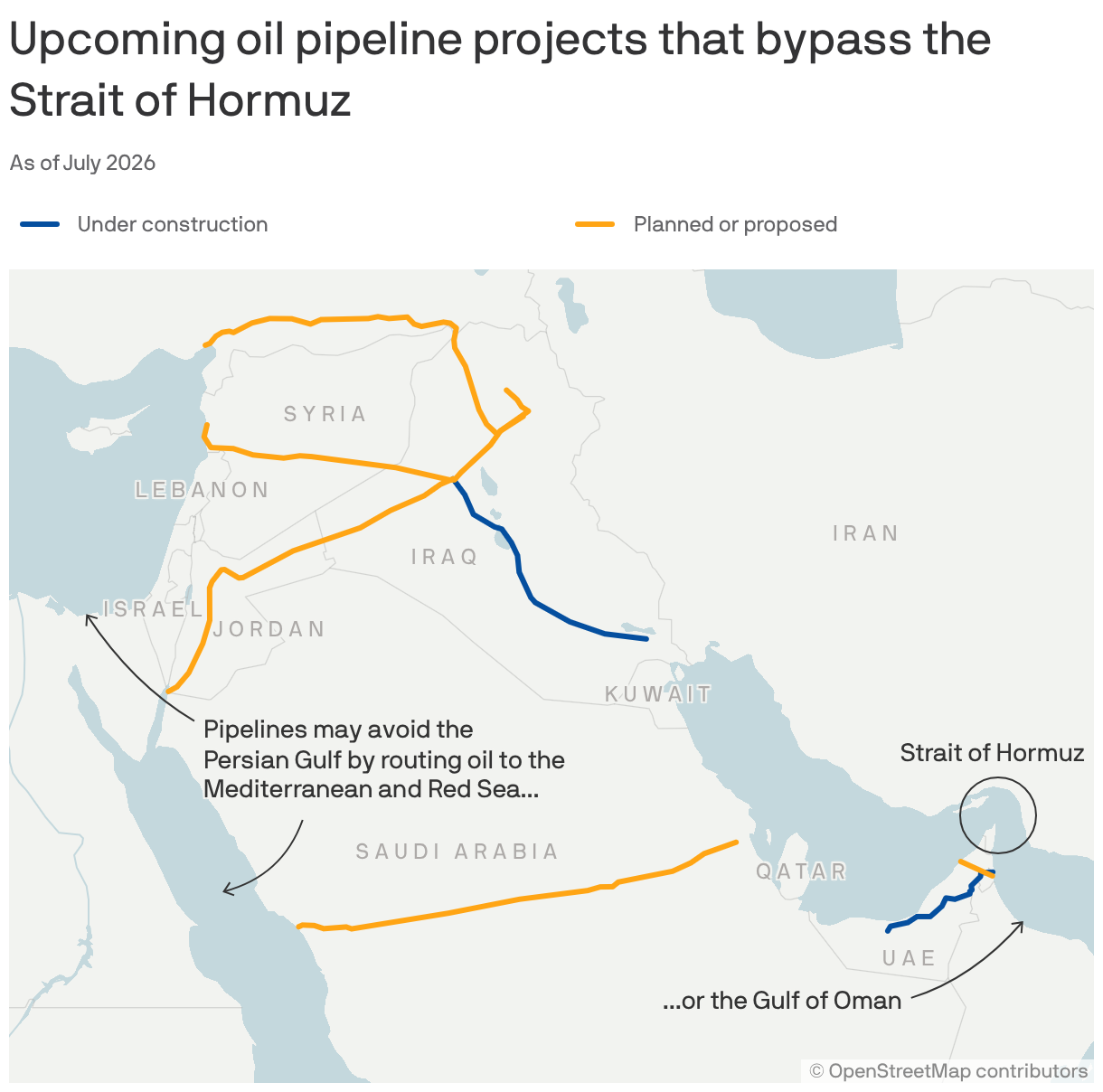
The Strait of Hormuz, a key waterway for global energy trade, has become a focal point due to the U.S.-Iran war. As a result, countries and companies are exploring alternative routes to reduce dependence on the strait. President Trump's recent remarks about reinstating a blockade and proposing a toll have added to the urgency.
The U.S.-Iran war has highlighted the importance of the Strait of Hormuz, with the oil market's top players seeking to bypass the waterway. According to Bloomberg Intelligence analysts, the war may ultimately be remembered for accelerating global efforts to reduce dependence on the strait. The ceasefire agreement between the U.S. and Iran is unraveling, with President Trump proposing to reinstate a blockade and charge a 20% toll on cargo shipped through the strait.
The threat of a toll, although potentially without legal basis, has given producers an incentive to explore alternative shipment methods. Oil prices have risen, with the price of a barrel of benchmark Brent crude oil reaching $86.57. Commodity analysts at Goldman Sachs have identified seven pipeline and export-infrastructure projects under construction, planned, or considered potentially feasible. These projects could insulate more than 45% of the pre-war level of Persian Gulf producers' exports from potential future Hormuz shocks by the end of next year.
Two projects, the West-East pipeline in the UAE and the Basra-Haditha Pipeline in Iraq, are already under construction. A Dubai-based port operator is in talks to develop a new port on the UAE coast to reduce the country's dependence on the strait. Construction for these pipelines is expected to be relatively quick, with a median completion time of 2.5 years. However, the world still needs the strait, with 7 million to 9 million barrels of crude and refined products per day remaining exposed to its risks even after a rerouting buildout.
Go Deeper
What is the Strait of Hormuz and why is it important?
The Strait of Hormuz is a key waterway for global energy trade, with roughly 20% of the world's oil flowing through it. Its importance has been highlighted due to the U.S.-Iran war, which has led to a search for alternative routes to reduce dependence on the strait.
What has President Trump proposed regarding the Strait of Hormuz?
President Trump has proposed reinstating a blockade of the Strait of Hormuz and charging a 20% toll on cargo shipped through it. However, the International Maritime Organization says there is no legal basis for such a toll.
How are countries and companies responding to the situation?
Countries and companies are exploring alternative routes to reduce dependence on the Strait of Hormuz. Several pipeline and export-infrastructure projects are under construction, planned, or considered potentially feasible, which could insulate a significant portion of Persian Gulf producers' exports from potential future Hormuz shocks.
What is the current state of oil prices?
The price of a barrel of benchmark Brent crude oil has risen to $86.57, partly due to President Trump's remarks about reinstating a blockade and proposing a toll.
What are the potential long-term implications of the situation?
The global trade in oil is likely to be reshaped as a result of the U.S.-Iran war and the efforts to bypass the Strait of Hormuz. The development of alternative routes and infrastructure could reduce dependence on the strait and increase the resilience of the global energy market.
More world
 world
worldBBC Releases List of Highest-Paid Presenters for 2025-2026
The BBC has published its list of highest-paid presenters for the 2025-2026 financial year. Scott Mills and Greg James are among the top earners.
Jul 14 world
worldBBC Calls for New Funding Model
The BBC is seeking a new funding model to replace the licence fee. The call comes as the corporation faces serious challenges, according to its annual
Jul 14 world
worldWiddecombe Gives Interview Before Alleged Attack
Ann Widdecombe, a former Conservative minister, gave an interview approximately 20 minutes before an alleged attack occurred. The incident is currentl
Jul 14